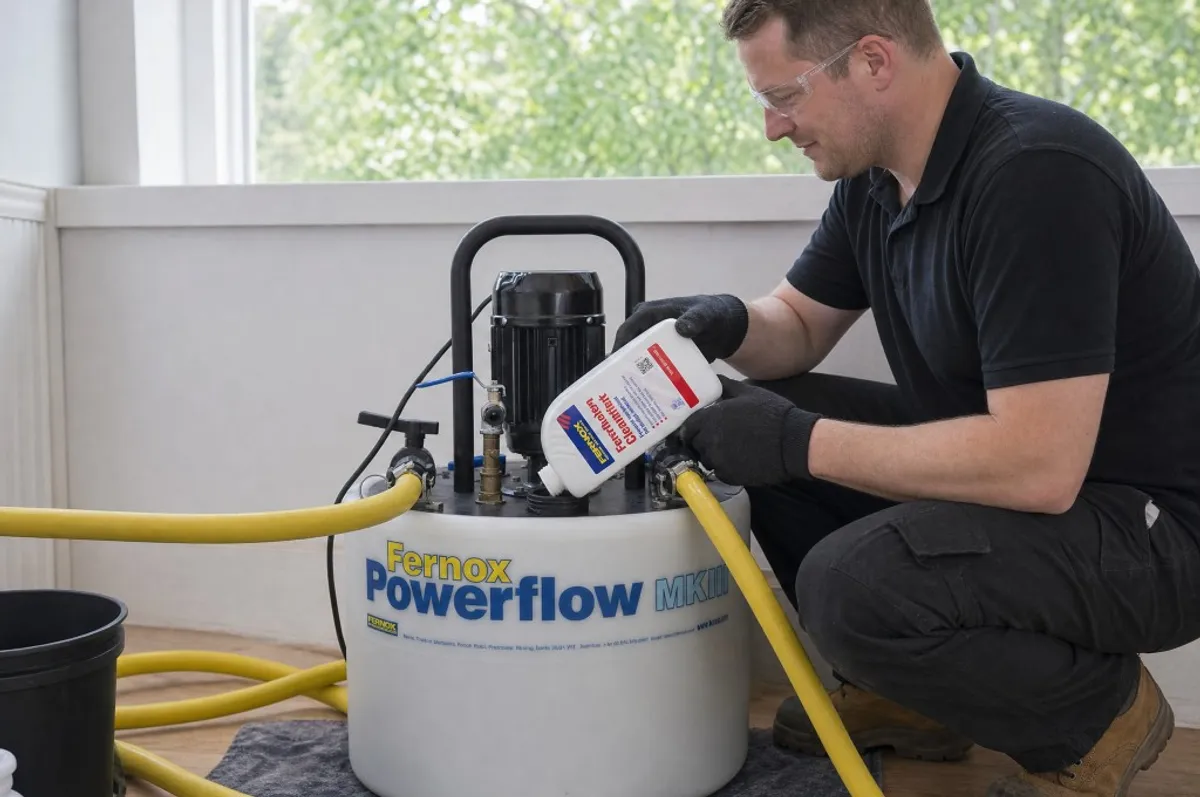
If you have had a power flush—or you are about to replace your boiler—you will almost certainly be offered a magnetic filter. Sometimes called a boiler filter, magnetic separator, or system filter, it is a small unit fitted on the pipe before water enters the boiler. It is one of the best ways to stop black sludge coming back. But is it essential, how does it work, and which brand should you choose?
What does a magnetic boiler filter do?
Inside the filter is a powerful neodymium magnet. As heating water flows through, the magnet pulls iron oxide particles (magnetite) out of suspension before they reach the boiler pump and heat exchanger. Non-magnetic debris can also be trapped in the mesh or hydrocyclonic chamber depending on the model.
Think of it as an oil filter for your engine—your boiler lasts longer when the fluid circulating through it is clean.
Why manufacturers insist on one
Worcester Bosch, Ideal, Baxi, Vaillant and most major brands now expect a system filter on new installations. If sludge causes a breakdown and no filter is present, warranty claims can be rejected—the manufacturer argues the system was not protected as instructed.
Warranty reality
A £150 filter fitted after a power flush is cheap insurance compared with losing a £2,000 warranty repair because rust destroyed the heat exchanger.
Filter vs power flush: different jobs
- Power flush — removes sludge already in the system (one-off deep clean)
- Magnetic filter — catches new rust particles day after day (ongoing protection)
- Inhibitor chemical — coats metal to slow new corrosion forming
You need all three for a proper result: flush the old dirt out, inhibitor to slow new rust, filter to catch what still forms. Fitting a filter on a dirty system without flushing first just traps sludge at the boiler while the rest of the pipework stays blocked.
Can you add a filter to an old boiler?
Yes. Retrofitting to an existing combi or system boiler is straightforward—usually spliced into the return pipe where water goes back into the boiler. Installation typically takes 1–2 hours. Best done immediately after a power flush when the water is already clean.
Popular brands in Northern Ireland
Adey MagnaClean
The industry benchmark. Dual-action models capture magnetic and non-magnetic debris. Widely recognised by boiler manufacturers and heating engineers across NI.
Fernox TF1
Uses hydrocyclonic action plus a magnet. Robust, good flow rates, popular on larger systems with more radiators.
BoilerMag
High-intensity magnet with large collection capacity—suited to bigger properties and heavier sludge loads.
We install all three brands—choice depends on boiler location, pipe size, and budget. See our magnetic filter service page for more detail.
How often should a filter be cleaned?
Once a year at the annual boiler service. The engineer opens the filter, removes the magnet, wipes or washes collected sludge, and reassembles. Takes about 10–15 minutes. If the canister is full of thick black mud every year, your inhibitor level may be low or the system may need another flush.
What does installation cost in NI?
Supply and fit typically runs £120–£200 depending on brand and access. Some homeowners bundle filter fitting with a power flush to save a second visit—we often quote magnetic filter installation from £150 when combined with a full flush.
Bottom line
If you have had—or need—a power flush, fit a magnetic filter at the same time. It is one of the few heating upgrades that pays for itself by preventing a single boiler failure.